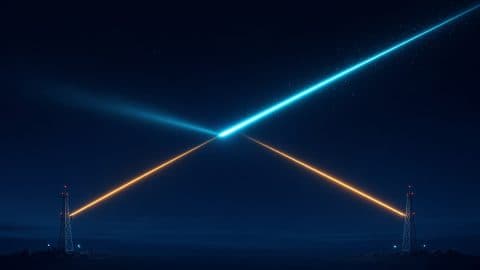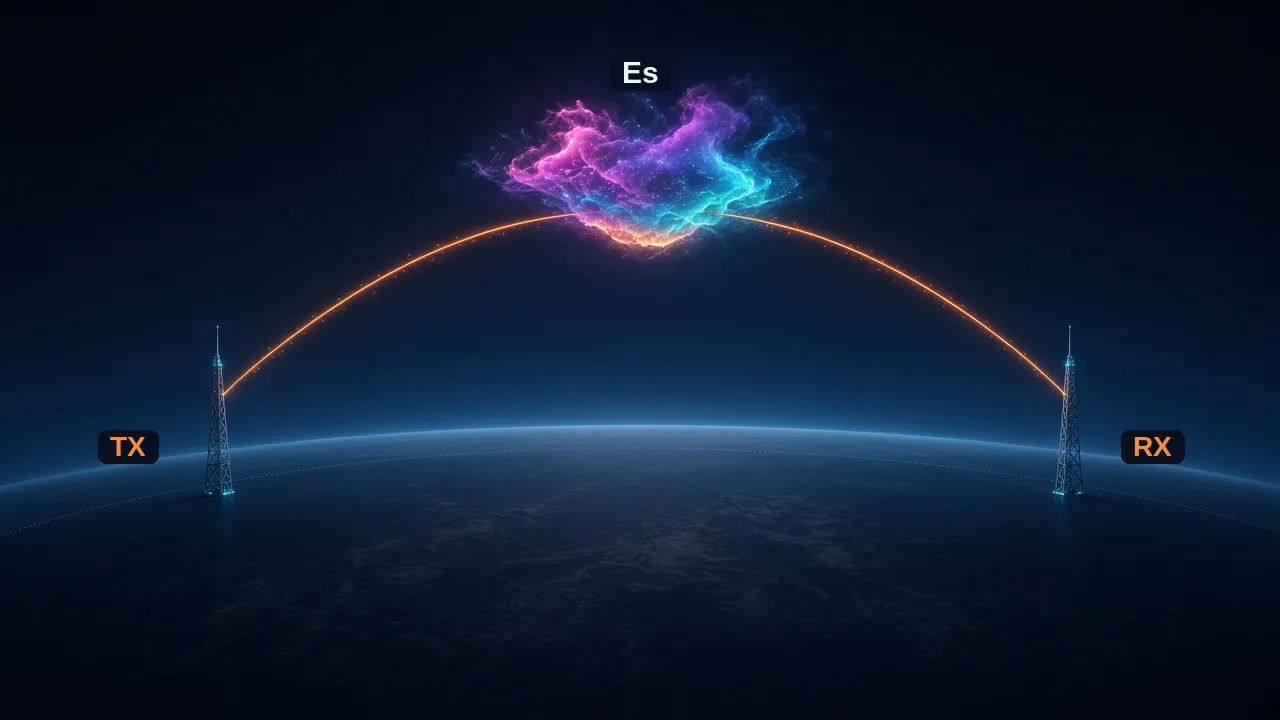
In June 2026, during the Northern Hemisphere's summer sporadic-E season, 6-meter operators worked contacts of 1,000 to 1,500 miles with 100 watts and a horizontal loop, then watched the band fall silent within the hour. That is sporadic-E: a transient, patchy layer of dense ionization in the E-region that bends VHF signals back toward Earth far beyond the horizon.
Sporadic-E, usually written Es, forms between roughly 90 and 120 km altitude. The individual patches are thin, often only one to two kilometers thick, and their electron density can reach about five times the peak value of a sunspot maximum. That density is what lets a layer that normally passes 50 MHz straight through instead refract it back toward the ground.
 TangoXray
What Sporadic-E Is and Where It Forms
The normal E-layer does not reflect VHF signals. During an Es event, wind shear in the upper atmosphere compresses long-lived metallic ions, largely left behind by ablating meteors, into thin, dense sheets. Atmospheric gravity waves help concentrate those ions into the nodes that become reflective patches.
The leading explanation is the wind shear theory, and it is the reason Es is not driven primarily by the solar cycle.
The precise mechanisms for mid-latitude sporadic-E formation remain unresolved after decades of study, though wind shear, meteor ablation, and gravity waves are the leading contributors.
, Summary of published Es research
That distinction matters for planning. A rising or falling sunspot number does not tell you whether 6 meters will open. Es is a lower-atmosphere phenomenon, and it behaves differently from F-layer HF propagation.
Which VHF Bands and Distances Es Supports
Es most often affects the lower VHF range. The 6-meter band at 50 MHz is the classic case, and 4 meters near 70 MHz is also strongly affected where that band is allocated. The 2-meter band at 144 MHz opens less often and usually for shorter periods, and signals occasionally reach into the 150 MHz region and above under strong conditions. Effectiveness drops as frequency rises.
Single-hop distances typically run from 600 to 1,500 miles (roughly 970 to 2,400 km). Double-hop paths between separate patches can push beyond 2,000 miles (about 3,200 km). Because the reflecting layer is thin and highly ionized, path loss is low and received signals are often strong even from low-power stations.
Band access is not universal, so treat three layers separately before you transmit. The ITU region sets the broad frequency allocation framework, the IARU band plan gives a regional recommendation for how that spectrum is used, and your national regulator publishes the chart that actually applies to your license class and permitted power.
Never assume an IARU Region 1 chart describes conditions in Region 2 or Region 3.
Season, Time of Day, and Why Prediction Stays Hard
Es shows a clear seasonal rhythm. In the Northern Hemisphere, activity builds from mid-May, peaks near the June solstice, and tapers after mid-July. A smaller secondary peak arrives around the December solstice. In the Southern Hemisphere the main peak falls near the December solstice, so the next major window for both hemispheres is the December period.
Diurnally, openings cluster in the late morning and early evening, though Es can appear at almost any hour. None of this yields a precise forecast. Patches form suddenly, last anywhere from a few minutes to a few hours, and vanish just as quickly.
Openings are also localized: a station 20 miles from one enjoying an Es contact may hear nothing at all, because the reflective cloud covers only a limited region and drifts with upper atmospheric winds.
Reading the Signal: Strength, Flutter, and Interference
Es signals are often strong and clear, sometimes with a slight flutter, and they can range from barely detectable to overloading the receiver. On single-hop paths the transmitted polarization is largely retained, which is why horizontal polarization is the common choice on 6 and 2 meters.
The same mechanism that helps amateurs causes problems elsewhere. A 1945 FCC engineering study found that Es produced interference about 1 percent of the time for a station at 42 MHz, but only about 0.01 percent for one at 84 MHz. Modern VHF FM broadcast, private mobile radio, and digital television can all be carried well outside their intended service areas during an opening, sometimes at high strength.
Tracking is improving. The Air Force Research Laboratory has demonstrated a method that uses unintentional RF emissions from power lines to map dense Es structures over large regions. In Japan, researchers monitor anomalous propagation of aeronautical navigation signals in the 108 to 118 MHz range alongside GPS-derived electron density data to visualize Es layers in two dimensions.
Consolidated amateur reception reports remain a useful supplement where ionosondes are sparse.
Longer-term studies of the sporadic-E critical frequency, foEs, using multi-decadal ionosonde records show regional and latitudinal trends that are not primarily solar-driven. Some mid-latitude stations show positive trends consistent with increased carbon dioxide concentrations altering thermospheric wind shear, which could shift how intense and how long-lived future Es layers become.
How to Work Es Openings
Success with Es comes down to vigilance and speed. Watch beacons, listen for distant stations appearing on normally quiet frequencies, and be ready to move when the band comes alive. Keep transmissions short so you can react to a fading or shifting opening.
- Monitor beacons and known calling frequencies before and during the season
- Use horizontal polarization on 6 and 2 meters where your setup allows
- Keep CQs and exchanges concise, and repeat calls every few minutes
- Log time, frequency, and signal strength to learn your local patterns
- Distinguish Es from tropospheric ducting, which builds and fades slowly between fixed endpoints
Check Yourself
You should now be able to explain why sporadic-E is not tied to the solar cycle, why a nearby station can miss an opening you are working, and why 50 MHz opens far more often than 144 MHz. You should also be able to name the three layers of band planning that decide where you may legally transmit.
The next propagation idea worth studying is tropospheric ducting, the slower, lower-altitude counterpart that behaves very differently from Es and rewards a different operating approach.