After this lesson, you will be able to explain how a meteor trail becomes a radio path and why meteor scatter contacts arrive as short pings instead of a steady signal.
The Trail Is the Reflector
 TangoXray
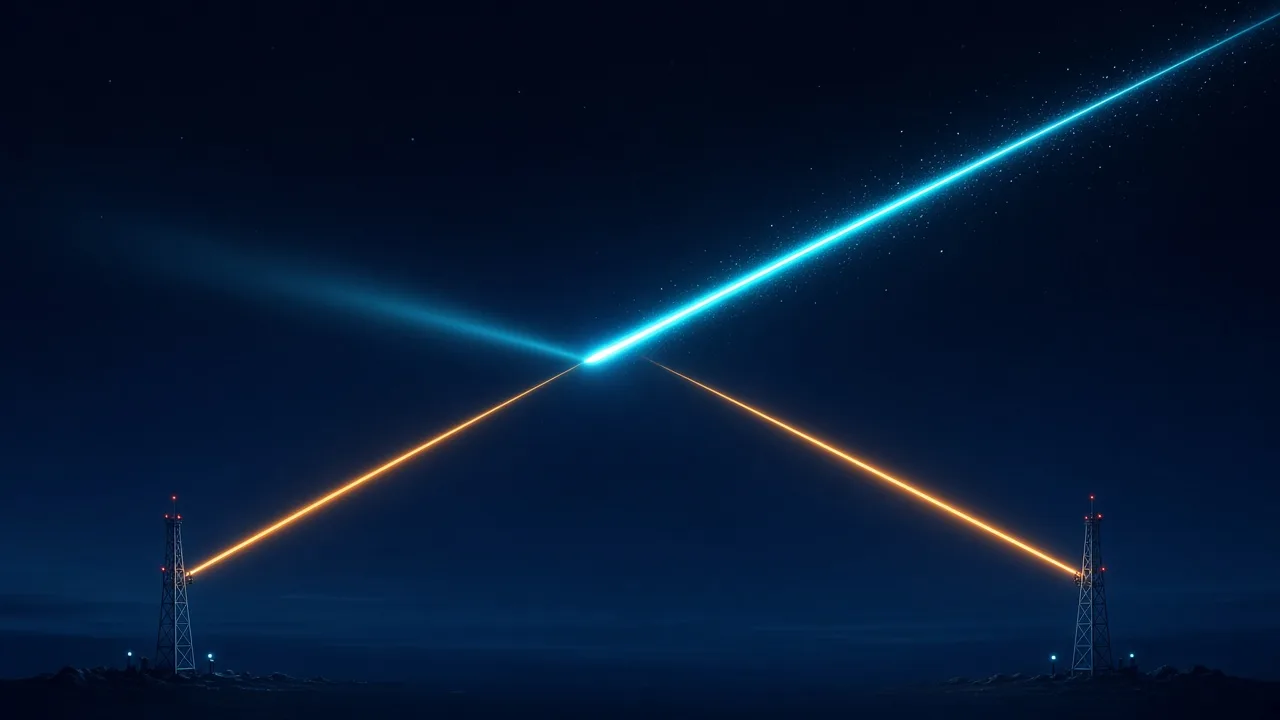
Every day, huge numbers of dust grains and small pebbles hit the upper atmosphere. Most burn up between 85 and 120 kilometers up, in the E layer. Friction vaporizes the particle and strips electrons from the surrounding air, leaving a thin line of ionized gas. That plasma trail is dense enough to reflect radio waves, but only for a moment. It's like a mirror that appears, works once, and then vanishes.
Why the Contact Comes in Pings
The usual geometry is forward scatter. Your signal travels up to the trail, and the trail sends part of that energy down to a station far beyond your horizon. Because the trail exists briefly, the path opens briefly. You hear a short burst, often called a ping, then silence while you wait for the next usable trail. Nothing is wrong with your receiver during that silence. The channel itself is gone.
Distances and Bands That Work
Meteor scatter paths run roughly 500 to 2,250 kilometers, with the best results near 1,000 kilometers. Shorter paths need very steep reflection angles that trails rarely support, and longer paths are blocked by the curve of the Earth. Most activity sits between 30 and 150 MHz.
The 6 meter band at 50 MHz is the classic choice, and 144 MHz on 2 meters is popular but harder because reflected power drops as frequency rises.
Timing, Sequences, and Software
Modern meteor scatter contacts use MSK144 inside WSJT-X. The mode repeats short frames through a 15-second transmit and receive period, so a decode can survive a ping of about 70 milliseconds or longer. Direction sets the sequence.
Stations beaming east transmit on even cycles (00 and 30 seconds past the minute). Stations beaming west transmit on odd cycles (15 and 45 seconds). Keep your computer clock synchronized to within a fraction of a second, and coordinate with your partner in a chat room such as Ping Jockey or ON4KST.
- Clock synchronized to a reliable time source
- MSK144 selected, 15-second T/R period
- Antenna aimed at the correct azimuth
- Chat window open for coordination
Antennas, Power, and Patience
A directional antenna such as a Yagi helps, but more gain is not always better. A beamwidth of about 32 degrees is suitable for paths around 800 kilometers, while 16 degrees is better for the longest paths. Too narrow a beam can miss the scattering volume.
On 2 meters, a receive preamplifier is common practice. On 6 meters, stations often run 100 watts or more. Early morning, around 6 AM local time, tends to be the best window because the Earth sweeps up more meteors on its leading edge.
Major showers such as the Perseids and Geminids raise the trail rate well above the sporadic background.
Check Yourself
- Why does a meteor scatter path open and close within seconds?
- Why is there a minimum useful distance of about 500 kilometers?
- Which station transmits on even cycles, and why?
One common mistake: giving up after a minute of silence. Meteor scatter is intermittent by design, and a completed contact can take many minutes of waiting between pings.
Next, the syllabus covers how the ionosphere bends and reflects signals at lower frequencies, explaining the differences in HF and VHF propagation.