Every radio wave you transmit starts with charge moving in a conductor. Key the microphone, and electrons in the antenna slosh back and forth. That motion is what launches the wave. You do not need the SI size of one electron to use a radio. You do need a clear picture of what those charges do when you press the PTT.
This lesson covers one idea: radio is the motion of charged particles, and matter is what supplies those particles. By the end you should be able to explain why copper works as an antenna and glass does not, and why a radio wave can pass through a wall but still heat the water in your coffee.
 TangoXray
Atoms, and why metals give up their outer electrons
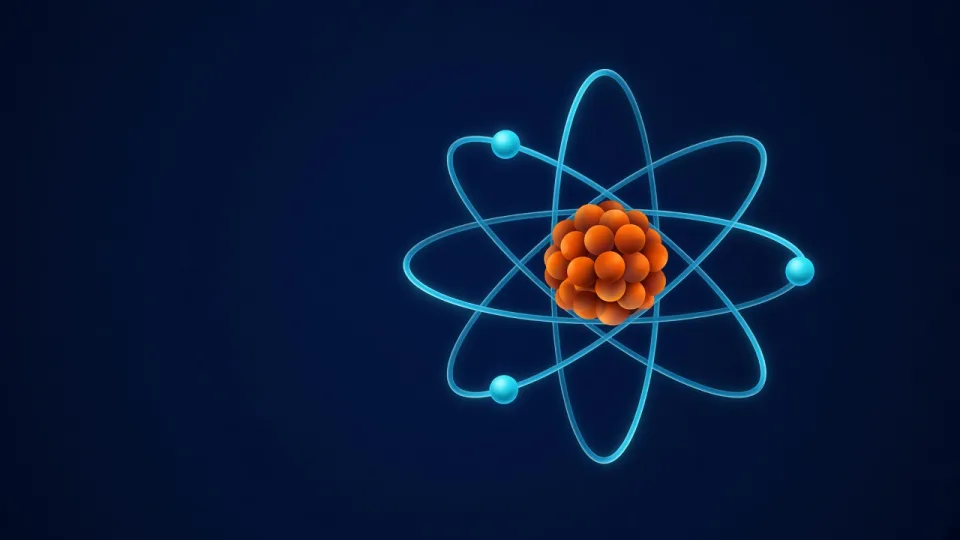
Matter is anything with mass that occupies space. Its basic unit is the atom, typically about 100 picometers across. Each atom has a dense nucleus of positively charged protons and neutral neutrons, surrounded by a cloud of negatively charged electrons. In a neutral atom the counts balance, so the net charge is zero.
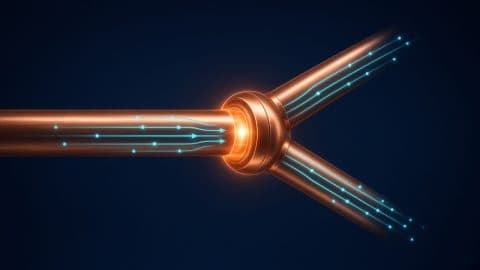
What matters for radio is not the nucleus but the outermost electrons. In metals such as copper and aluminum, those outer electrons are only loosely bound. They drift from atom to atom, forming what is often described as a sea of free electrons.
That mobility is what makes a metal a conductor. In insulators such as glass, rubber, or dry air, electrons stay tied to their atoms, so current does not flow easily. When you choose antenna wire, you are choosing a material with a large supply of electrons that respond to a field with very little opposition.
Electric charge is the force behind every antenna
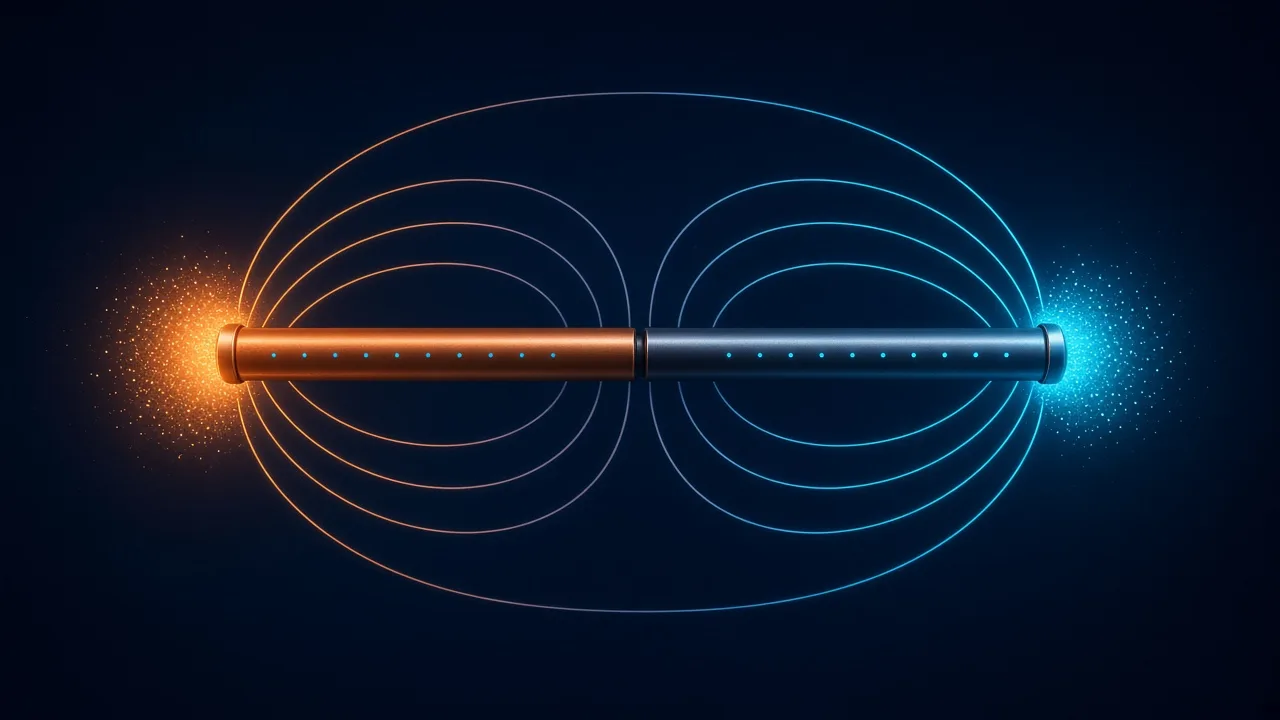
Charge is a property of matter that makes a particle feel a force in an electromagnetic field. There are two signs. Protons are positive, electrons are negative, and the rule is simple: like charges repel, opposite charges attract. That attraction is what holds electrons to the nucleus in the first place.
Charge is quantized. It arrives in discrete units of the elementary charge, and it is conserved: it is never created or destroyed, only moved. When you connect a battery to a circuit, you are not manufacturing charge. You are pushing existing electrons around a loop.
How oscillating electrons make a radio wave
A stationary charge produces a static field. A charge moving at constant velocity produces a steady current and a steady magnetic field. Neither radiates. Acceleration is the ingredient that matters.
Drive an alternating current into an antenna and the free electrons inside it reverse direction at the operating frequency. On the 10 m band, for example, that reversal happens roughly 28 million times per second, and one full wave in free space spans about 10.7 m.
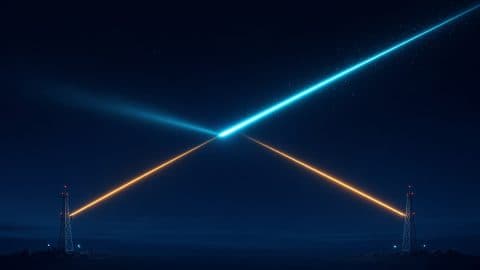
Each electron's back-and-forth acceleration produces a changing electric field, and a changing electric field produces a perpendicular magnetic field. The two sustain each other and detach from the conductor, propagating outward at the speed of light.
This is why frequency and wavelength are locked together. The rate at which you force the electrons to oscillate sets the frequency of the wave that leaves the antenna. Nothing about the wire's color, weight, or brand changes that relationship.
Reception: the same physics run backwards
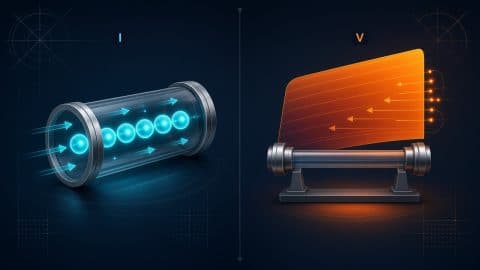
At the receiving end, the incoming wave's electric field exerts a force on the free electrons in the receiving antenna. They oscillate in step with the wave, producing a tiny alternating voltage and current. That induced signal is a much weaker copy of what flowed in the transmitting antenna, and it is what your receiver's front end amplifies and downconverts.
Two practical consequences follow. First, a receive antenna with more free electrons and better conductivity delivers more signal and less thermal noise of its own. Second, reciprocity is real: a structure that radiates efficiently at a given frequency also captures energy efficiently at that frequency, though the surrounding noise environment and matching network still shape what you actually hear.
- Can you state the sign and magnitude of an electron's charge?
- Can you explain why copper conducts and glass does not, using the idea of bound versus free electrons?
- Can you name the one property of a moving charge that produces radiation?
- Can you explain why radio waves pass through a wooden wall but heat food in a microwave oven?
Why radio passes through walls but heats food
Radio waves sit at the low-energy end of the electromagnetic spectrum, far below visible light, X-rays, and gamma rays. A radio photon carries on the order of 10⁻²⁸ to 10⁻²² joules depending on frequency, which is nowhere near enough to strip an electron from an atom. Radio is non-ionizing. It does not break chemical bonds, and it does not make materials radioactive.
That does not mean radio ignores matter. In conductors, it drives free electrons, which is exactly what an antenna exploits and what causes losses in nearby metal objects. In materials containing polar molecules, such as water, the oscillating electric field torques those molecules back and forth, and that molecular rotation shows up as heat.
The same mechanism that lets a microwave oven cook rice is the mechanism that makes wet foliage attenuate a signal on a high band.
So the answer to the common beginner question is: radio interacts with matter through charge, not through chemistry. Where charges are free to move, you get currents and radiation. Where charges are bound but lopsided, you get absorption and heating. Where neither applies, the wave mostly passes through.
A short history worth knowing
James Clerk Maxwell published the equations that unified electricity and magnetism in the 1860s and predicted that coupled electric and magnetic fields could travel through space. Heinrich Hertz demonstrated those waves experimentally in 1887, showing they reflected, refracted, and diffracted like light.
Guglielmo Marconi built practical transmitters and receivers around 1894 to 1895, and commercial radio service followed around 1900.
The physics did not change between Maxwell and your handheld. Only the engineering did.
Where to go next
The natural next step is impedance. Once you accept that electrons move in response to fields, the question becomes how efficiently a given structure converts that motion into a radiated wave, and how well it accepts power from a feed line. That leads to resonance, standing waves, and the matching networks you will meet in any antenna handbook.
For licensing and permitted power, always check your national regulator's current requirements, since privileges vary by country and by license class. Band plans are layered as well: ITU region, IARU recommendations, and the national chart each say something different, and none of them is universal.