By the end of this lesson, you will be able to explain how Kirchhoff's current law and Kirchhoff's voltage law track every amp and every volt in a DC circuit, similar to how a ledger tracks every entry in an account.
Why Ohm's Law alone runs out
Ohm's Law handles one resistor at a time. A single loop with a source and one resistor is easy. Add a second path, a shared node, or two sources, and you can no longer reduce the circuit to one V = IR step. You need a system that accounts for all the paths at once. Gustav Kirchhoff published that system in 1845. The two rules function like conservation laws in accounting.
 TangoXray
Kirchhoff's current law: nodes balance
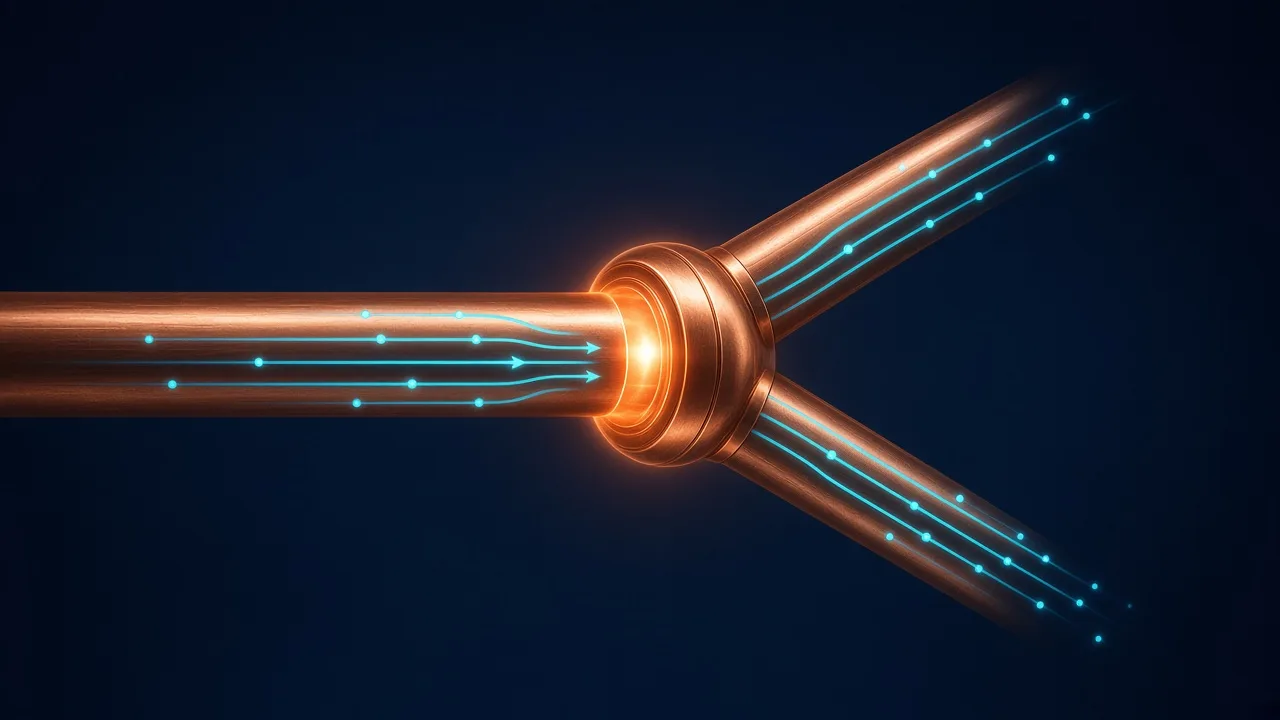
A node is any point where three or more conductors meet. Kirchhoff's current law (KCL) says the total current entering a node equals the total current leaving it. Charge does not pile up at a junction in steady state. Nothing is created, nothing is lost.
Written as an equation, the algebraic sum of the currents at a node is zero. If 1.45 A enters a node and 0.87 A leaves on one branch, then 0.58 A must leave on the other. That is the whole idea. KCL is a statement about conservation of charge.
Kirchhoff's voltage law: loops balance
A loop is any closed path you can trace from a point back to that same point. Kirchhoff's voltage law (KVL) says the algebraic sum of the voltages around that loop is zero. Every rise is canceled by a drop. KVL is a statement about conservation of energy.
Picture a 9 V battery feeding two 1 kohm resistors in series. The current is 9 V divided by 2 kohm, or 4.5 mA. Each resistor drops 4.5 V. Walk the loop: +9 V across the battery, then -4.5 V, then -4.5 V. The calculations balance.
Sign conventions are the hard part
The physics is straightforward, but the bookkeeping can be tricky. Before you write any equation, do three things: mark every node, assume a direction for each branch current and draw the arrow, and choose a direction to walk each loop, clockwise or counter-clockwise, then keep it.
If a solved current comes out negative, your assumed arrow pointed the wrong way. The magnitude is still correct. Do not flip the arrow mid-solution and start over. A negative answer is information, not an error.
Combining KCL, KVL, and Ohm's Law
Kirchhoff's rules give you the structure. Ohm's Law fills in the values. Replace each resistor voltage in a KVL equation with I times R for that branch, and the unknowns become currents. Now you have a system of linear equations you can solve by substitution, elimination, or matrix methods.
For a circuit with n nodes, you can write n minus 1 independent KCL equations. Any more just repeat information you already have. The same caution applies to loops: pick independent loops, not every loop you can draw.
- Mark nodes and loops before writing anything
- Assume current directions and keep them
- Write one KCL equation per independent node
- Write one KVL equation per independent loop
- Substitute V = IR and solve
- Check the answer by plugging it back in
Check yourself
Answer these without looking back.
- A node has 2 A entering on one branch and 0.5 A leaving on another. How much leaves on the third branch?
- A loop contains a 12 V source and two resistor drops of 5 V and 7 V. Does KVL hold?
- You solve for a branch current and get -3 mA. What does the minus sign tell you?
Common mistake: writing more loop equations than the circuit has independent loops. The extra equations are not wrong, they are redundant, and they make the algebra harder than it needs to be.
Kirchhoff's rules are the doorway to nodal and mesh analysis, the two systematic methods you will use for every circuit after this one.