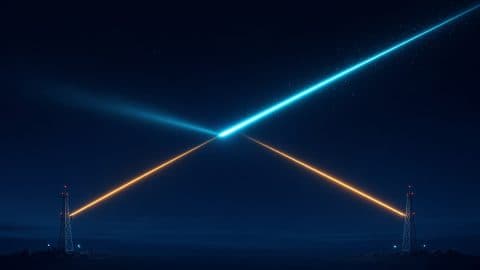
After this lesson you will be able to explain how a geomagnetic storm turns the polar E layer into a VHF reflector, and why the signal sounds the way it does.
The Aurora Is a Mirror Made of Moving Plasma
 TangoXray
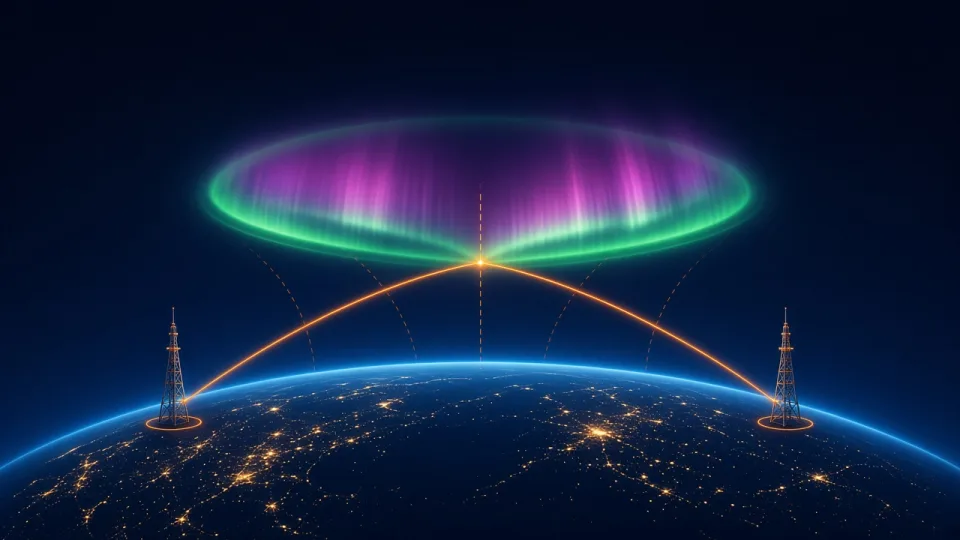
Solar flares and coronal mass ejections throw charged particles toward Earth. The planet's magnetic field funnels them into the polar regions, where they collide with gas molecules roughly 100 to 120 km up, inside the E layer. That collision energy raises ionization across a ragged, drifting patch.
For HF, the same event often means absorption and blackout. For VHF, the patch can scatter a signal back down to the ground. That is why auroral contacts are described as auroral backscatter rather than simple reflection.
Why Auroral Signals Sound Raspy
The scatterers are not fixed. Ionization drifts and reforms constantly, so a single transmitted frequency arrives as many slightly shifted copies. You hear that as a hollow, fluttery, watery, or raspy tone. The shift is Doppler shift, and it grows with frequency: a few hundred hertz at 50 MHz becomes roughly a kilohertz at 144 MHz. That is the practical reason voice gets harder to copy as you move up in frequency.
Aim at the Aurora, Not at the Other Station
Auroral paths are not great-circle paths. Each station points its beam into the auroral zone, north in the Northern Hemisphere and south in the Southern Hemisphere, and the signal scatters off the curtain to reach the other operator. Aim straight at the distant station and you will usually hear nothing. Expect contacts in roughly the 800 to 1800 km range; paths beyond 2000 km are unusual.
Modes That Survive the Distortion
CW is the workhorse. Its narrow bandwidth tolerates the smearing and the flutter. SSB is possible, especially at 50 MHz, but often sounds like a loud whisper. Wideband FM is generally unusable because the Doppler spread blurs the modulation into a smear. Narrow, robust digital waveforms can decode, but wide modes struggle badly.
Reading the Space Weather
The Kp index summarizes global geomagnetic activity on a 0 to 9 scale. Values of 5 and above mark storm conditions, which is when auroral VHF paths become likely. The OVATION model forecasts aurora location and intensity roughly 30 to 90 minutes ahead, about as much warning as you get.
Events last minutes to a couple of hours. Some operators report better odds between 1400 and 2000 UTC, and sources note higher incidence in February, April, July, and October, though no month guarantees activity.
- Check the Kp index before you turn the radio on
- Point the beam into the auroral zone, not at the target
- Start on CW, then try SSB if signals are strong
- Keep overs short, the opening may close without warning
Check yourself
- Why does a VHF signal come back to Earth during an auroral event?
- Why is CW easier to copy than SSB on an auroral path?
- Which direction do you point your beam?
Common mistake: aiming the beam at the distant station instead of into the auroral zone, then concluding the band is dead.
Next up in the syllabus: sporadic E, another E-layer path that arrives without any geomagnetic storm at all.