After this lesson, you will be able to explain how an Earth-Moon-Earth contact works, why the path loss is so extreme, and what causes a moonbounce signal to wander and fade.
What Earth-Moon-Earth Communication Is
 TangoXray
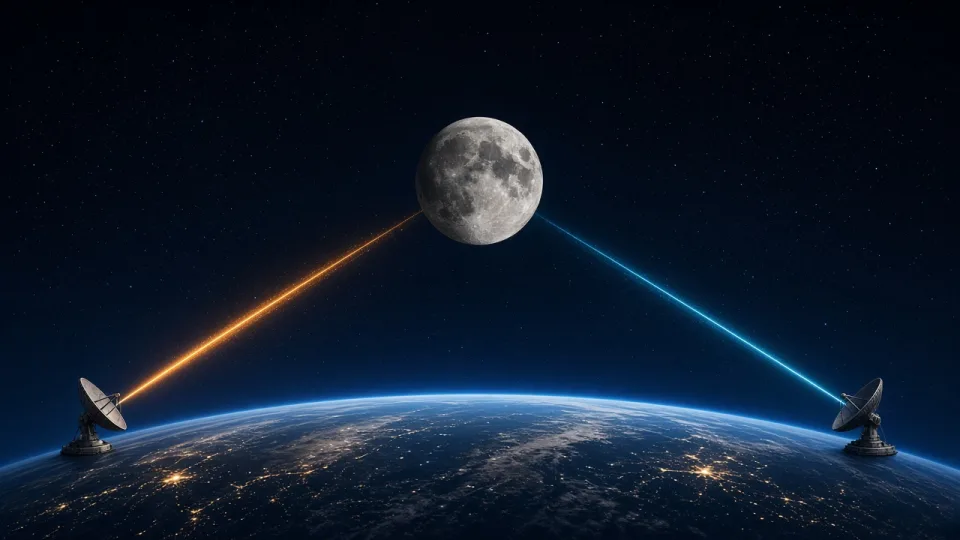
EME, also called moonbounce, uses the Moon as a passive reflector. You point an antenna at the Moon, transmit, and let the lunar surface scatter a small part of that energy back toward Earth. Any station that also sees the Moon can try to hear you.
The concept was proposed in 1940 by W.J. Bray of the British General Post Office. On January 10, 1946, the U.S.
Army Signal Corps recorded the first radar echoes from the Moon during Project Diana at Fort Monmouth, New Jersey. Amateur operators detected lunar echoes in 1953, and the first two-way amateur EME contact happened in 1960 between W6HB and W1FZJ on 1296 MHz.
Why the Path Loss Is So Brutal
The Moon is about 384,400 km away on average, so a signal travels roughly 750,000 km round trip. The lunar surface is rocky and rough rather than smooth, so it scatters most of the energy and returns only about 6-7 percent. The result is a total round-trip path loss of about 252 dB at 144 MHz, 261 dB at 432 MHz, and 271 dB at 1296 MHz.
Nothing about your station changes those numbers. You can only compensate with antenna gain, low-noise receive, and time.
Doppler Shift, Libration Fading, and Faraday Rotation
Three effects keep an EME signal from behaving like a steady carrier. Doppler shift comes from relative motion: expect a few hundred hertz at 144 MHz near moonrise and moonset, and up to about 4 kHz at 1296 MHz. Libration fading comes from the Moon's slight wobble and rough surface, which spreads the echo and makes it sound rough or mushy.
Faraday rotation twists the polarization of the wave as it crosses the ionosphere, and a polarization mismatch can cost 20-30 dB. Above 1296 MHz, circular polarization is the usual answer.
What an EME Station Needs
Gain is the first requirement, and a mast-mounted low-noise amplifier is the second. A preamp with a noise figure near 0.5 dB keeps receiver noise below the sky noise that dominates at 144 MHz. Transmitter power helps, but it is not the whole story.
The Moon moves through a 2 to 5 degree arc roughly every 10 minutes, so tracking has to keep up. Smaller stations can borrow ground gain during the hour after moonrise and the hour before moonset.
- Antenna aimed and tracking the Moon within a degree or two
- Mast-mounted preamp powered and working
- Doppler correction applied in the receive window
- Realistic expectation for your gain and mode
Digital Modes Changed Who Can Do EME
Weak-signal digital modes such as JT65, Q65, and FT8 decode signals far below what the ear can follow. That shifted the entry point. A 50 W transmitter into a 6-element Yagi on 2 meters, or 100 W into a 13 dBd Yagi, has produced real contacts. Voice and CW still work, but they reward large antenna arrays. Most newcomers start on 144 MHz because it balances antenna size against path loss.
Rules Come in Three Layers
EME operating frequencies sit inside amateur allocations, and power limits differ by country. Keep three layers separate: your ITU region, the IARU band plan recommendation, and your national regulator's chart. An IARU recommendation is not a license condition on its own. Check your national regulator before you raise power or change band.
Check yourself
- What does the Moon actually do to the radio signal?
- Why can a polarization mismatch cost you 20-30 dB?
- What makes a moonbounce echo sound rough instead of clean?
Common mistake: assuming that more transmitter power fixes everything. A poorly aimed antenna, or a receiver without a mast-mounted preamp, will lose more than an amplifier can recover.
The next concept to explore is the link budget, which includes antenna gain, feedline loss, and receiver noise figure, and determines whether your station can close the path.