Ohm's Law Without the Intimidation
By the end of this lesson you will be able to explain, in plain words, what resistance does in a circuit and how voltage, current, and resistance lock together through Ohm's law.
Resistance Is Just Friction for Electrons
 TangoXray
Resistance is the opposition a material offers to the flow of electric current. When a voltage pushes electrons through a wire, those electrons bump into atoms along the way. Each bump costs energy and slows the flow. That is resistance, and it is measured in ohms, written with the Greek letter omega.
Four things change how much resistance a piece of wire or a component has. The material matters, since copper conducts easily while rubber barely conducts at all. Length matters, because a longer path means more collisions. Thickness matters, because a fat wire gives electrons more room and lowers resistance. Temperature matters too, and for most metals resistance climbs as things get hotter.
One Formula, Three Letters
Ohm's law ties the three quantities together in a single relationship.
V = I x R
Voltage (V) is the electrical push, measured in volts. Current (I) is the flow of charge, measured in amperes. Resistance (R) is the opposition, measured in ohms. The current through a conductor is directly proportional to the voltage across it and inversely proportional to its resistance.
That word "inversely" is doing real work. Raise the voltage and current rises with it. Raise the resistance and current falls. Georg Simon Ohm published this relationship in 1827 after building his own batteries, wires, and galvanometer. His critics dismissed it at first. The math survived them.
Feel It at the Power Supply
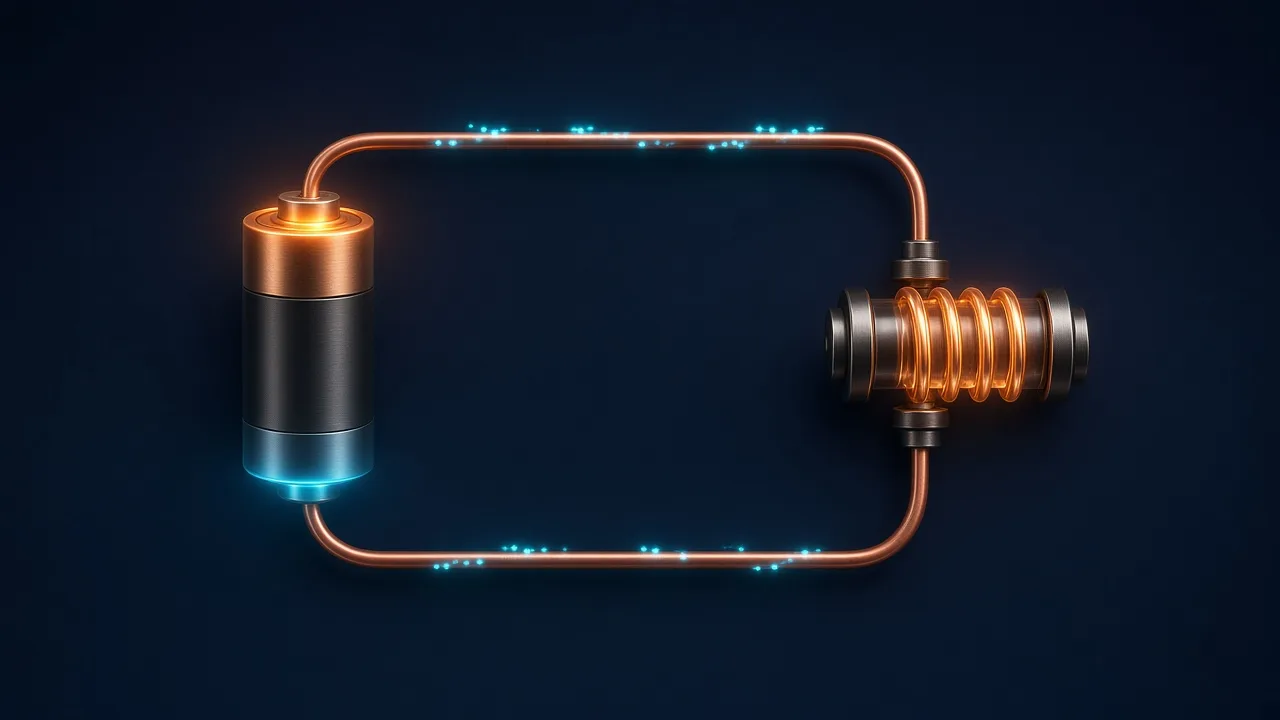
This is where the idea stops being abstract. Put a fixed resistor across a variable bench supply and watch the current meter as you turn the voltage knob up. Current climbs steadily. The resistor did not change, so the extra push produced extra flow.
Now hold the voltage steady and swap in a larger resistor. Current drops. Same push, more opposition, less flow. You have just demonstrated both halves of Ohm's law with two knobs and one meter.
A practical version of this shows up when you size a supply for a radio. A rig that draws 50 watts at 13.8 volts needs about 3.6 amperes, since I = P / V. Most operators then pick a supply rated well above that figure, because running a supply flat out shortens its life and leaves no headroom.
Rearranging the Formula Without Panic
You will rarely need to solve for voltage. Most of the time you know the voltage and want the current, or you know both and want the resistance. Two rearrangements cover nearly everything.
I = V / R gives you current from voltage and resistance. R = V / I gives you resistance from voltage and current.
Try one. A 9 volt battery across a 3 ohm resistor carries 3 amperes, because 9 divided by 3 equals 3. Try another. A circuit running 12 volts at 2 amperes has 6 ohms of resistance, because 12 divided by 2 equals 6. The arithmetic is division, nothing more.
- Write down the two values you already know.
- Pick the rearrangement that leaves the unknown alone.
- Check the units before you divide: volts, amperes, ohms.
- Sanity check the answer. A small resistor should give a large current.
Where Ohm's Law Stops Being Simple
Ohm's law holds cleanly for ohmic materials, where resistance stays constant as voltage changes. Most metal conductors behave this way under normal conditions.
It breaks down for non-ohmic devices. Diodes and transistors do not hold a fixed resistance, so their voltage and current do not track in a straight line. Even a resistor drifts once it heats up. Treat the formula as a reliable tool inside its range, not as a universal law of nature.
Check Yourself
- If you double the voltage across a fixed resistor, what happens to the current?
- A 12 volt supply feeds a 4 ohm load. How much current flows?
- Why does a longer wire have more resistance than a short one of the same thickness?
A common mistake is mixing units, such as dividing milliamperes by volts and expecting ohms. Convert to amperes first, then calculate.
The next idea to pick up is power, where voltage and current combine into watts and explain why components get warm.