After this lesson you will be able to explain how a temperature inversion bends VHF and UHF signals past the horizon, and how that trapped path differs from tropospheric scatter.
The troposphere bends radio waves
 TangoXray
The troposphere is the lowest layer of the atmosphere, roughly the first 7 to 20 km above the ground. It holds most of the atmosphere's water vapor and almost all of its weather. Temperature, pressure, and humidity all change with height inside it, and those changes set the refractive index of the air.
Where the refractive index changes, a radio wave curves. In ordinary air the curve is gentle, which is why the practical radio horizon reaches a little farther than the geometric horizon you would draw with a ruler. Nothing exotic is happening yet. You are just watching air bend a wave.
What a temperature inversion is
Normally, air gets cooler as you climb. In an inversion, that pattern flips: a layer of warmer air sits on top of cooler air. Two common causes are clear, calm nights, when the ground radiates heat away faster than the air above it, and high-pressure weather, where sinking air warms as it descends.
Cool, moist air trapped under warm, dry air is the useful case for radio. The two layers have very different refractive indices, and the boundary between them is sharp.
Ducting: the atmosphere as a waveguide
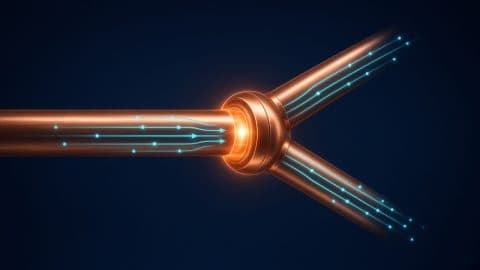
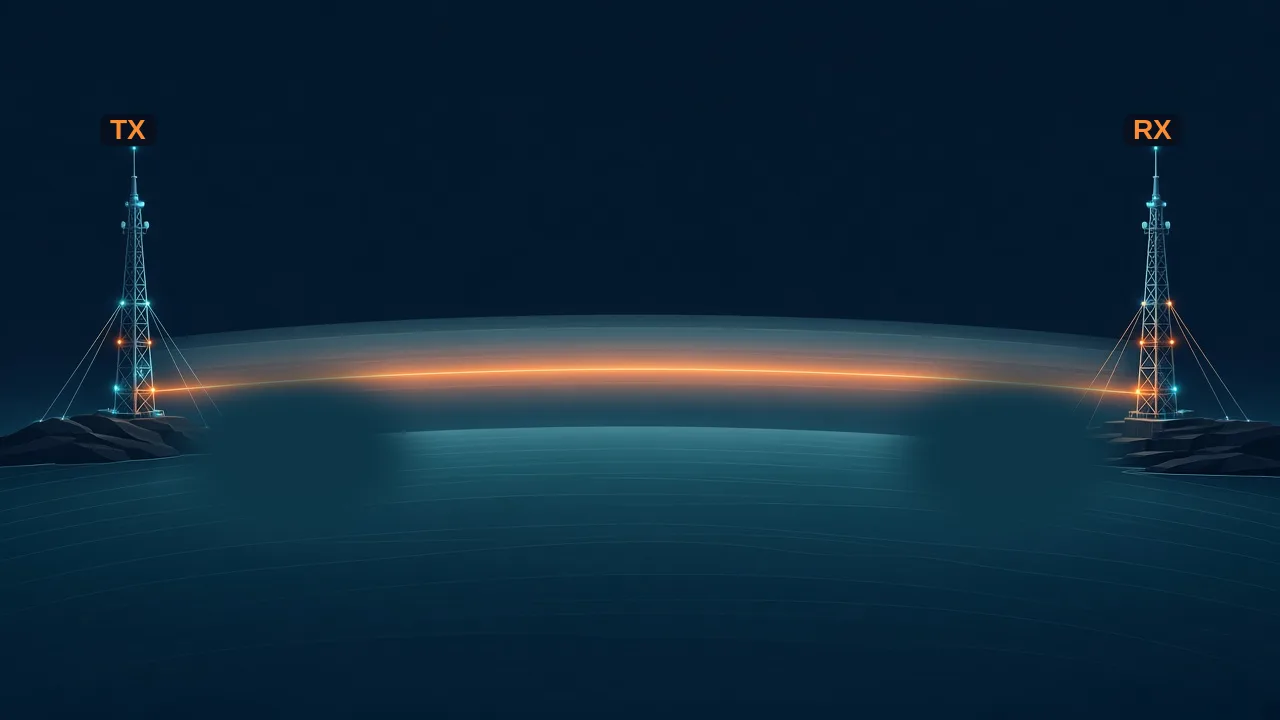
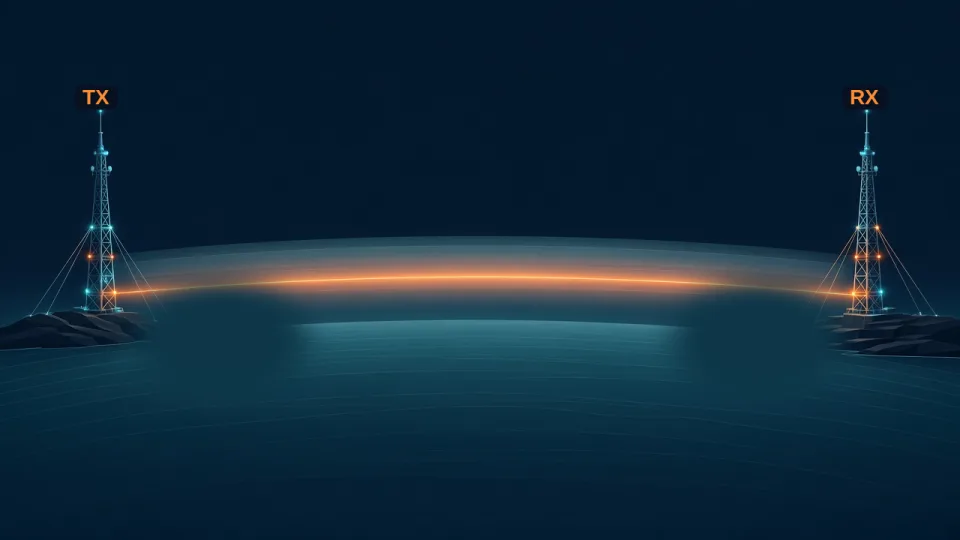
When the vertical gradient is strong enough, the downward bend matches the curvature of the Earth. The wave no longer escapes. It bends down, meets the ground or the inversion layer, and bends again. It is trapped in a duct.
Ducts come in two shapes. A surface duct traps the wave between the ground and an inversion layer above it. An elevated duct traps the wave between two layers, with normal air below. Both let VHF and UHF signals travel hundreds of kilometers, and strong events have carried them well past 1,000 km.
This is the same mechanism behind a distant repeater or broadcast station appearing on a local channel, and behind interference that shows up on public safety and mobile networks far from its source.
Scatter: a different path
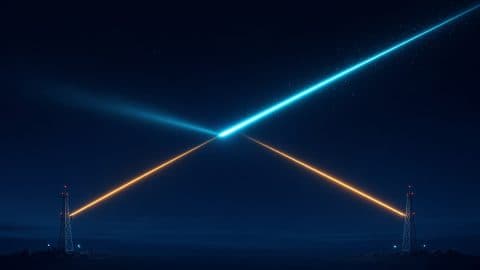
Tropospheric scatter does not trap anything. You aim a beam just above the horizon at a shared volume of turbulent air. A small fraction of the energy scatters toward a distant receiver. Links of roughly 100 to 700 km are the usual working range.
The signal fades hard and fast, on top of a slowly changing average level. That fast fading is the signature of scatter, and it is why troposcatter systems need margin and diversity. The technique carried military beyond-line-of-sight traffic from the 1950s until satellites took over in the 1970s, and it is returning as an alternative when satellite links are contested.
Which bands, and what to expect
Ducting mostly matters at 30 MHz and above, more often above 90 MHz, and it reaches into the microwave bands. Troposcatter systems commonly work from 144 MHz through 10 GHz, with around 2 GHz often cited as a good compromise.
Band plans and power limits are not worldwide. Treat them as three layers: your ITU region, the relevant IARU recommendation, and your national chart. For what you may transmit, and at what power, check your national regulator.
- Is the weather high-pressure, clear, and calm?
- Is the signal on a band above 30 MHz, with a low take-off angle?
- Is the path mostly flat or over water?
- Does the signal fade fast, or hold steady for minutes at a time?
- Can you rule out a local transmitter on the same channel?
Check yourself
- What happens to air temperature with height during an inversion, and why does that matter for radio?
- How does a duct differ from troposcatter in the way the signal reaches the far end?
- Why is fast fading a clue that you are hearing scatter rather than a duct?
A common mistake is calling every strong distant VHF signal "tropo." Sporadic E, equipment faults, and a distant transmitter on the same channel all look similar at first. Check the weather, check the band, and check the fading before you name the mechanism.
Next in the syllabus: how the ionosphere bends HF signals, a higher layer with a very different set of rules.